Showing posts with label Vaccine. Show all posts

Monday, August 17, 2015

Vaccines and baby-steps: more on my pet peeves

Vaccination's dangers don't fall evenly
I've been donning my grandmother-hat more  than usual these days which is the case, I'm sure, for many of you in the northern hemisphere.  Blogging has been relegated to the back burner so this post will be brief and time lagged.

First, I recommend reading Jane Brody's August 10th column in the New York Times. It's about vaccines and, like all the others I've read about the controversy, it omits the fact that vaccines pose a higher risk for children with pre-existing neurological impairments than for healthy ones.

I thank Elizabeth Aquino for linking to the Pediatrics article which reports the results of a study of vaccinated children. Here is the abstract (link): the full-text of the article requires a subscription.

The researchers concluded that:
their results suggest that in most cases, genetic or structural defects are the underlying cause of epilepsy with onset after vaccination.... These results have significant added value in counseling of parents of children with vaccination-related first seizures, and they might help to support public faith in vaccination programs. 
The comment I sent Brody received only 5 recommends. I doubt it made the slightest dent in the conventional wisdom that our children - those with pre-existing neurological impairment - need no exemption from compulsory vaccination laws. But the comments were even more interesting than the article and you can still add yours to the 353 already up.

I also called the local organization which, along with several others, invited the CEO of Lumos, Georgette Mulheir, to speak at a conference held here in May. The lawyer of that organization, which assists cognitively disabled adults, told me that the conference primarily involved a project underway here to transfer 900 adults residing in closed institutions into homes within the community. The goal is to integrate them in every way, including employment.
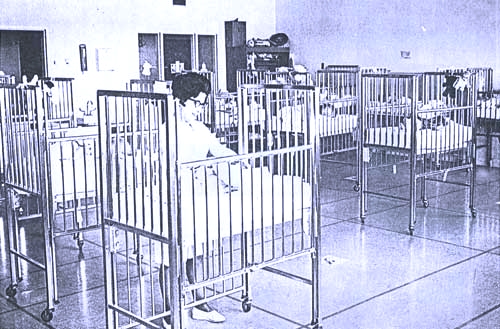
Classic image: Institutionalized baby care
According to the lawyer, one year after the project was launched the organization has just begun testing potential candidates to determine which will be most likely to succeed. Next stage will be the search for jobs. She conceded that only those with the highest level of functioning will be considered. I'd call it a baby-step - in slow motion - in the right direction. I'm not impressed.

I was shocked to hear that the lawyer knew almost nothing about our country's large chain of closed institutions for people with disabilities. I've written several livid articles about that thriving, government-subsidized enterprise and she asked me to send the links (which I did).

So, Lumos' Mulheir came and left without learning about our entrenched system of institutionalization. What a squandered opportunity.

Now for another excerpt from Mulheir's speech: She gave an example of how de-institutionalization was effected in one country:
We found that in Bulgaria there are over 200 children with hydrocephalus. That's fluid on the brain. If it isn't treated, the head continues to grow and expand. The end is a painful death. In Bulgaria, the surgery these children needed was provided by the state but the drain, the device needed to provide the children with subsequent quality of life, was not. Consequently those children were institutionalized. Working with the government authorities in Bulgaria and Romania, we demonstrated that the cost of keeping a child in an institution far exceeds the cost of the drain these children require. That money could be spent on providing the drains in place of funding institutional care. The annual cost of institutionalization is 63,960 Euro while each drain costs only 1,500 Euro. Only after seeing the numbers were the authorities convinced to provide the drains and hundreds of children who underwent the surgery now live normal lives within the community. Another point in Bulgaria: children were dying of malnutrition in institutions at the  rate of 3 per month. When the time allotted to meals was examined in one of the institutions, it was found that each child had on average one minute and 20 seconds to eat. Without intervention and change, many more children would have died there. Today the Bulgarian government is working on this. Some institutions still remain but many children have been transferred to the community and mortality has dropped to almost zero.

Thursday, July 16, 2015

Bruni versus Kennedy: The ugly match

A heated altercation played out last week between the preeminent NYTimes columnist Frank Bruni and Robert Kennedy Jr.

In a scathing ad hominum attack on Kennedy, Bruni lauds the new California law mandating vaccines for all but the immune-compromised. Bruni's snide, puerile jabs at Kennedy were shocking - regardless of whether you agree or not with his warnings of vaccine risks.

You had to wonder how Bruni's July 4, 2015 piece passed editorial muster. He wastes no time lobbing the blows. The tirade begins:
If you had told me a while back that I’d someday dread, dodge and elect not to return phone calls from a prominent member of the Kennedy dynasty, I would have said you were nuts.
Then Robert Kennedy Jr. started reaching out.
Not just reaching out, mind you, but volunteering to educate me. To illuminate me. That was his tone of voice, somewhat pitying and vaguely patronizing, the one time we talked at length, after he’d left messages and before he left more.
It was important, he said, that we meet.
If we did, he said, he could correct me.
My error?
I had disparaged the alarmists who claim a connection between vaccines and autism and fill parents with needless fears about immunizing their children.
I had sided with the American Medical Association, the American Academy of Pediatrics, the National Institutes of Health and the Centers for Disease Control and Prevention. Kennedy knew better...
You can read Bruni's full hissy-fit ("California, Camelot and Vaccines", NY Times, July 4, 2015) here. It was reassuring to see that Kennedy promptly posted a candid intelligent response on Facebook and on his personal site (here):
Frank Bruni's angry tirade against me in his Sunday New York Times column took me by surprise. Last February, we'd had a brief, friendly, and mutually respectful telephone conversation. He had written an article about vaccine safety at the end of January and I asked if he would allow me to show him some of the recent scientific studies linking thimerosal to a range of brain injuries. I also wanted to show him the transcripts of statements by CDC whistleblower, Dr. William Thompson, discussing the troubling disarray and deception within CDC's vaccine program...
Then on July 10, his Letter to the Editor appeared in the NYTimes (here).

One of Kennedy’s utterances that particularly riled Bruni was this one:
"They get the shot, that night they have a fever of a hundred and three, they go to sleep, and three months later their brain is gone..."
Kennedy (left) and Bruni (right)
Asks Bruni incredulously:
Their brain is gone?
As one mother for whom this cynical question is literally relevant, I'd like to respond:
"Yes, Mr. Bruni, in certain cases their brain is  gone: utterly, irreversibly and tragically."
The background, what happened to my daughter, is in this December 2013 post of mine.

I'd like to reiterate: at the very least, I advocate exempting children who are already neurologically impaired from vaccinations. Just the way immune-compromised children are exempted today.

Ideally, though, I'd like more. The medical establishment owes parents of the neurologically-impaired a pre-vaccination warning. They deserve to know that vaccines pose a significantly higher risk to their children than to the general population. There's some important information about that in an article published last September in the medical journal Pediatrics: see "Etiologies for Seizures Around the Time of Vaccination". Then they can decide whether to run that risk.

Doesn’t that sound reasonable? Readers, what do you think?